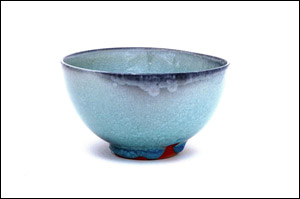
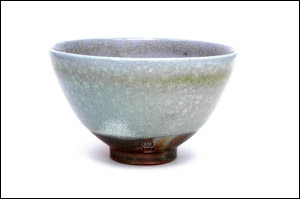
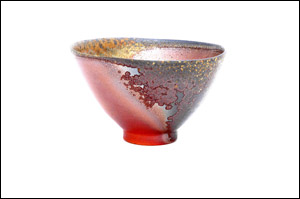
Below: Kick wheel with turnings and bai-tunze bowls
that
we do, so that our lives are carbon neutral. We have 18 solar photovoltaic
cells on our roof to create our own electricity, selling the excess
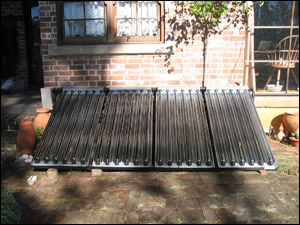
back to the grid as green power. We recently upgraded our solar hot water
panels from the old copper tube system to evacuated glass tube units
which are very much more efficient, minimising the need for off-peak
boosting.
When we had to buy a new fridge/freezer in 1992, we purchased
the most energy efficient model (5 ½ stars out of 6) on the market
at that time. There is now a fridge/freezer available that is twice as
efficient and a fridge that is four times as efficient. We changed to
a front-loading washing machine 15 years ago when our old one needed
to be replaced; these machines are much more water and energy efficient
than top loaders.
We recognised long ago that our politicians are as
lazy as the voters who elected them are naïve and ill informed.
If there was to be any progress, then we had to go it alone, and start
to make that difference ourselves regardless of the political system
and the mass market. We have been walking the walk for some time, now
we can talk about it.
This process has been long and gradual. We are now
carbon neutral, and slightly energy positive. We have achieved this
on a low income and without too much pain. Sometimes, people ask me how
we did it and what can they do.
Well, what can you do? There are lots of things.
The next time you need
to think about buying another car, don’t get
a big 6- or 8-cylinder petrol guzzling 4X4 dinosaur, buy a small car.
You will find that your fuel bill will drop remarkably, giving you extra
dollars every week. The money you save on petrol can be used to pay off
the loan, if not in whole, then at least in part. Spend the remaining
money that you would have had to spend on the bigger vehicle on photovoltaic
solar panels for your roof and you will have free or, at least, very
much cheaper electricity, for the rest of your life and the electricity
utility company will pay you for any excess power, for the rest of your
life. Now this small rebate from the excess electricity money can be
used to purchase low-energy white goods like fridge, washing machine
etc. over time reinvesting the green dividend. These new ‘green’ appliances
will use less electricity, which cuts your energy usage further and means
a bigger rebate from the electricity utility.
Just by changing your car,
you might be able to drive for nothing for the rest of your life, using
the money saved and the extra electricity rebate to eventually pay for
your fuel. You can still fire your small electric kiln, as long as you
buy some carbon credits to offset the coal used to generate the electricity.
If you change to the slightly more expensive certified pure green energy,
then carbon credits are not involved. It’s
worth thinking about.
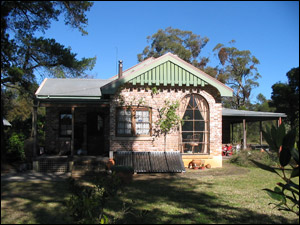
We have 18 photovoltaic cells on our roof (35 sq
m) which generate approximately 3000 watts and pump out an avarage of 11 kW hrs
of electricity per day over the year. We consume approximately
6 kW hrs on average of electricity per day over the year for the house,
pottery and kiln factory (we have operated a small kiln building factory,
making custom built gas, electric and wood-fired kilns for other potters
for the past 25 years. This involves the use of 300 amp Mig and Tig welders
and plasma cutters). This gives us an excess of 5 kW hrs of power per day, which we
sell back to the grid.
It might be possible to reverse
the global climate change, although I doubt it. However, if you are willing
to become informed, and then make a conscious decision to make a personal
difference, it might be possible. It might be that all you can do just
at the moment is to change vehicles, but there has to be some sort of
change of mind. We have to take pride in having a small car, or no car,
and to be proud to refuse air conditioning in both car and home. Janine
and I have done just this. We don’t own any
of the usual consumer excesses like air conditioning, dish washing machine
or large TV plasma screens. We own and use beautiful pots every day in
the kitchen. It doesn’t seem such a terrible chore to handle them
as we wash them up each meal, and we mostly use soap for washing both
pots and clothes, not detergents. As all our water is recycled back into
our garden, we have to live permanently with any toxins that we introduce
into our environment.
The time of small passive changes has probably been
missed. The only solution now will be a technologically advanced ones.
There are too many of us to go back to the forest, because it’s
been chipped. Our federal government in Australia is currently pushing
us towards the nuclear solution (without any debate about the options)
but I don’t believe that it has to
be nuclear. Why should future generations be asked to pay for our excesses
through the maintenance and removal of spent reactors and their highly
toxic waste? It is a sobering thought that no single spent nuclear reactor
has yet been successfully decommissioned anywhere in the world, and the
reason is that the costs are going to be stupendous, long term and on-going.
This means that my children and grandchildren are going to be paying
for the real costs of the electricity that we use.
In the seventies, Janine
and I decided that we would only have one child, as every child born
in an advanced, energy wasteful country like Australia, will consume
so much extra energy that it would make this problem so much worse at
a faster rate. This was in line with some fringe thinking at that time
of ZPG & NPG.1
|
 In the mid-seventies we moved to the outskirts
of the city, growing our own vegetables, collecting our own rain water,
cooking our food and heating our hot water on a wood fired stove, like
the locals had done for a century before. We were always inclined to ‘green’ attitudes,
although in those days, it was called weird, feral, alternate or self-reliant,
depending on whom you spoke to.
In the mid-seventies we moved to the outskirts
of the city, growing our own vegetables, collecting our own rain water,
cooking our food and heating our hot water on a wood fired stove, like
the locals had done for a century before. We were always inclined to ‘green’ attitudes,
although in those days, it was called weird, feral, alternate or self-reliant,
depending on whom you spoke to.